Presence of Al-Jaber at Muscat Talks Constitutes a Saudi Guarantee for Implementing Prisoner Exchange
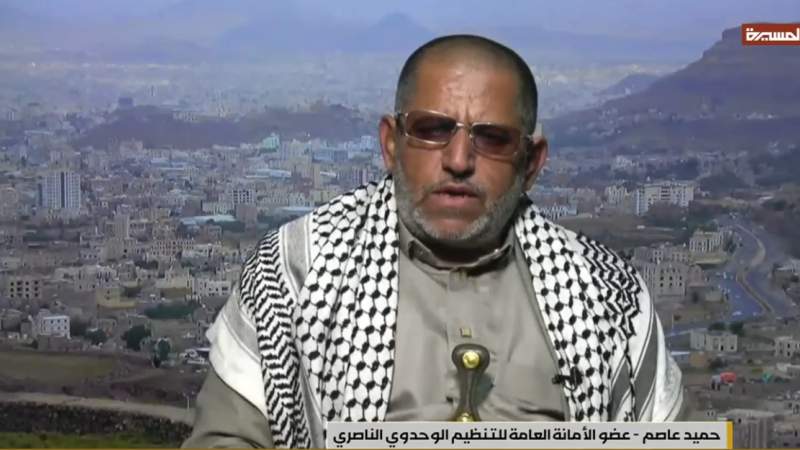
News - Yemen: Hamid Asim, member of the National Delegation, said the tenth round of prisoner exchange negotiations since the signing of the Stockholm Agreement in 2018 achieved unprecedented results, describing the outcome as a major humanitarian and political breakthrough.
In remarks to Al-Masirah TV on Wednesday, Asim said the conditions available during this round had never existed in previous talks, paving the way for a comprehensive agreement that marks tangible progress after years of obstruction.
He explained that the Stockholm Agreement explicitly stipulated the release of all prisoners from all parties without exception—whether held by Saudi Arabia, the UAE, or in Marib, Taiz, Aden, or other areas—in exchange for the full release of prisoners held by Sana'a. However, he said the agreement faced Saudi reluctance and deliberate obstruction from its earliest stages, delaying implementation for years.
Asim noted that all prisoners held by Sana'a are fully documented by the National Committee for Prisoners’ Affairs, under direct supervision of the International Committee of the Red Cross and the Red Crescent, with complete records of identities, detention locations, and conditions. By contrast, he said the Saudi-backed side lacks even basic information regarding Yemeni prisoners held in its custody.
He described the most significant achievement of the current round as the agreement to release around 1,700 Yemeni prisoners held in Saudi Arabia, marking the first time Riyadh has officially acknowledged detaining such a large number of Yemeni prisoners, in addition to others held by affiliated forces.
Under the agreement, approximately 1,200 prisoners from the Saudi-led coalition and its affiliated factions will be released, including seven Saudis and 23 Sudanese nationals. Asim said the exchange represents a major advance credited to the National Committee in Sana'a and to Omani mediation efforts overseeing the humanitarian track.
For the first time, the agreement also includes highly sensitive humanitarian issues, notably missing persons, forcibly disappeared detainees, and remains, a development Asim described as a qualitative shift after years of refusal by the other side to engage seriously on these matters.
He said Sana'a possesses accurate and verified information on prisoners of war and remains and has handled the issue as a responsible authority, while the coalition and its affiliated forces continue to suffer from disorder and fragmentation in managing detainee-related matters. During the Stockholm talks, he recalled, incomplete and poorly documented lists were submitted by the Saudi-backeside.
Commenting on Saudi Arabia’s role, Asim said the attendance of Saudi Ambassador Mohammed Al-Jaber at the Muscat negotiations and his pledges to guarantee implementation come amid Riyadh’s attempts to contain escalating instability in southern and eastern regions and its failure to control local factions, particularly the so-called Southern Transitional Council.
He stressed that Saudi Arabia bears full responsibility, as prisoners are held across multiple detention sites under its direct or indirect influence, including in Marib, Aden, and inside Saudi territory—one of the main obstacles that previously hindered agreements.
Asim warned that past experience with Saudi Arabia has been “bitter,” citing repeated breaches of signed agreements, and cautioned that failure to implement the current deal within the agreed timeframe would have serious consequences, given the ongoing humanitarian suffering of Yemeni prisoners held by the Saudi-UAE coalition.
He concluded by saying the agreement represents a first step toward addressing broader humanitarian issues, including lifting restrictions on Sana’a airport and ports, reparations, and compensation for those affected, stressing that Yemeni patience is not limitless and that the consequences of continued delay would be significant.
Prisoner exchanges have been among the most sensitive humanitarian tracks in Yemen. Previous rounds, often brokered by Oman and facilitated by the UN and the ICRC, achieved partial releases but left thousands unaccounted for. The latest agreement—if fully implemented—would mark the first attempt to comprehensively resolve the issue by combining exchanges, prison inspections, the release of civilian detainees, and the recovery of remains under international oversight.
#Yemen #US-Saudi Aggression #Prisoner Exchange 25-12-24-
11:18
Palestinian sources: heavy tank fire by the Israeli enemy north of Al-Bureij Camp and east of Wadi Gaza Bridge in central Gaza Strip
10:55
Mohammed Abdulsalam: There is an opportunity for those who act wisely to address various issues caused by Saudi-American aggression against Yemen
10:55
Mohammed Abdulsalam: The bet on the continuation of aggression and blockade has failed and will only bring more losses
10:54
Mohammed Abdulsalam: The end of the coalition, leaving Saudi Arabia alone at the forefront, was a major shift last year
10:54
Mohammed Abdulsalam: The blockade on Yemeni airports and ports amounts to collective punishment of the Yemeni people